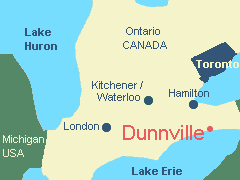
 Dunville, Ontario is a community in the city of Haldimand County (2006 pop. 45,212) on the north shore of Lake Erie.
The construction of a dam and canal designed to feed water from the Grand River to the new Welland Canal fostered the development of a settlement here during the late 1820s. A town plot, named Dunnville after John Henry Dunn, Receiver General of Upper Canada, was laid out and, following the opening of the Feeder Canal to navigation in 1829 the community thrived as a transshipment point and industrial centre. By 1832 it contained three store houses, a grist, fulling and carding mill and three saw mills. After the completion of the Second Welland Canal in 1845, Dunnville gradually lost its position as an active Lake Erie terminus for that waterway, but it continued to prosper and in 1860 assumed the status of a village.
 In 1940, a Royal Canadian Air Force Service Flying Training School on 400 acres outside Dunville opened. From then until the school closed in 1944, 2436 pilots were trained. 47 were killed in training and they are memoralized by a Harvard Mark II airplane.
Today, Dunville is promoted as a retirement and tourist community with condominiums and marinas along the river.
Saturday, May 31, 2008
Dunnville, Ontario
Saturday, May 24, 2008
Elora, Ontario
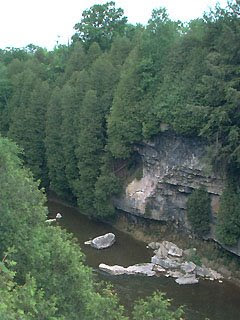 Elora, Ontario is on the Grand River, about 20 km northeast of Kitchener-Waterloo. It was incorporated as a village in 1858. In 1999, it was amalgamted with several other communities, including Fergus, Ontario, into the new Township of Centre Wellington (2006 pop 26,049).
Elora was founded by Captain William Gilkison (1777-1833) who was born in Irvine, Scotland, and emigrated to North America in 1796. He was a cousin of John Galt, founder of Guelph and Goderich, Ontario. In 1832, Gilkison purchased some 14,000 acres of land. The town site for his proposed settlement was laid out by Lewis Burwell, deputy provincial land surveyor, late in 1832, and the following year Gilkison established a sawmill and a general store.
 Today, Elora attracts tourists with its music festival, limestone architecture, river rafting and boutique shopping.
The mid-summer four-week Elora Festival, established in 1979, features classical choral music and jazz/blues.
Friday, May 16, 2008
Exeter, Ontario
 Exeter is the largest community in the municipality of South Huron (2006 pop. 9,982). South Huron was formed in 2001 when the townships of Stephen and Usborne were amalgamated with Exeter in 2001.
Exeter was laid out in 1855. The earliest settlers had been the families of James Willis and William McConnell who had come to the area in 1833. Within a year, McConnell had erected mills on the banks of the Aux Sables River near which a community known as Francistown developed. South of the mills near Willis's location on the "London Road", Isaac Carling opened a store and tannery in 1847 and James Pickard a general store in 1851. By 1860, Exeter had become the chief market centre of the district. In anticipation of the growth that the London, Huron and Bruce Railway would bring, Exeter and Francistown were amalgamated and incorporated as the village of Exeter on March 29, 1873.
 Trivitt Memorial Church, Exeter, Ontario was opened in 1883 replacing the first Anglican Church built in 1860. Its design is based on a portion of Exeter Cathedral in England. Thomas Trivitt, Justice of the Peace in Huron County, paid for the church after he had inherited a substantial estate.
Friday, May 9, 2008
Fergus, Ontario
 Fergus, Ontario is located 25km north of Guelph on the Grand River. It is the largest community in the Township of Centre Wellington (2006 pop. 26,049).
Fergus was founded by Adam Fergusson (1782-1862) and named in his honour. He first visited Canada in 1831 to explore colonization possibilities for the Highland Society of Scotland. In 1833 in partnership with a fellow Scot. James Webster (1808-69) he purchased over 7,000 acres of uncleared land in Nichol Township.
Attracted by the abundant water power they laid out the town site of Fergus. Webster took up residence and supervised the settlement's early development. The first house of this predominantly Scottish community was erected in 1833, a hotel the following year and a sawmill, grist-mill, church and school in 1835. Though Fergusson lived near Waterdown, and Webster moved to Guelph in 1852, the founders continued to foster the growth of their settlement.  The river is lined by a walkway and park. Shown are the Templin Gardens, restored in the 1970s.
Fergus celebrates its Scottish heritage by hosting Highland Games on the second full weekend in August. Begun in 1946 it now attracts over 30,000 people each year.
Today, Fergus is a thriving service centre with diverse industry. With its excellent access to Toronto and the Golden Triangle it is a growing residential community.
Saturday, May 3, 2008
Goderich, Ontario
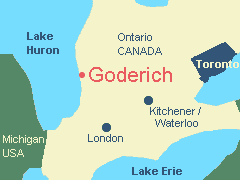
 Goderich, Ontario (2006 pop. 7,563) is located on the eastern shore of Lake Huron. In 1841 Goderich became the administrative and judicial centre for the newly created Huron District. Nine years later, with a population of about 1,000, the community was incorporated as a town.
In 1826 the Canada Company, a newly chartered colonization firm, acquired a large block of land known as the Huron Tract. The following year William "Tiger" Dunlop, appointed Warden of the Forests by the Company's first superintendent, John Galt, established his base here in the western part of the Tract. Named Goderich after the Colonial Secretary, Viscount Goderich, the site was initially marked only by "The Castle", Dunlop's residence, but a settlement gradually developed. By 1829 the Canada Company had surveyed a town plot, opened the Huron Road from Guelph, and established an office.
 The building shown has been the town hall since 1961. It was built in 1890 as a post office and customs house and was designed by Thomas Fuller, architect (with Chilion Jones) of the Centre Block of Parliament.
Sifto Canada, Inc operates the largest salt mine in the world underneath Goderich's harbour extending 5 km under Lake Huron.
Another company operating in Goderich is Volvo that operates a road grader manufacturing plant.